What Do You Call Art Animation With Sharp Edgeds
Edges in art refer to the transition between two shapes of color. Well-nigh people do not fully capeesh the importance of edges; color and composition ordinarily become all the spotlight.
In this mail service, you will learn everything you need to know about edges.

Nicolai Fechin, The Lady in Purple, 1908
What Creates Edges?
We encounter edges every time there is a change in:
Object: Marks the transition from 1 object to another. For example, if you lot place a coffee mug in front of you, edges will mark the transition from the mug to the surrounding desk-bound or wall.
Aeroplane: Marks the transition from i plane or face of an object to another face. For example, from the side of a box to the pinnacle of a box; or from the side of a cliff to the top of a cliff.
Color: Marks the transition from ane color to another. For example, the shadow cast on an object creates an edge which separates light and night. This type of edge is interesting considering it does non physically exist; we cannot touch an edge created mainly by a change in color. This means in painting, we are dealing with many more edges than what is physically there. So it is important that nosotros understand how to use them!
In the painting below, the edge which separates the land from the sky is created by a alter in object. The edge between the side and tiptop of the cliff is created by a alter in plane. The border at the bottom between shadow and light is a modify in color.

John Singer Sargent, The CLiffs at Deir El-Bahri, Egypt, 1891
Many errors in painting occur as a result of providing the wrong information through inappropriate edges. For example, placing a hard edge in the distant, foggy mountains where clarity is depression. Or using a soft border to marker what should be a sharp transition.
That is why information technology is important to have a general understanding of why and how we see edges. This knowledge will heighten your alarm bells whenever you paint an edge which just does not brand sense in the context of the painting.
Exercise: Take a look around correct now and place edges created by changes in object, plane or color.
Hard, Soft and Lost Edges
Identifying and capturing edges is only half the battle; you lot as well need to capture thenature of the edges. The most common terms artists use to describe the nature of edges are hard , soft and lost .
Hard edges signal an abrupt or sharp transition from one color shape to another.
Soft edges indicate a gradual or smoothen transition.
Lost edges are then soft you cannot actually run across them (merely you know an border is there based on other elements).
In the calm painting below, the ii figures are painted with relatively difficult edges. The shoreline and distant mountains are painted with soft edges. The horizon line which separates the ocean and the sky is a lost border (you know it is there merely yous cannot meet information technology).

Peder Severin Krøyer, Summer Evening on Skagen's Southern Embankment with Anna Ancher and Marie Krøyer, 1893
Other Factors Which Influence the Edges We See
Before in this post, I discussed how edges are created past a modify in object, plane or color. The following factors influence how we see those edges:
Low-cal:A strong, direct low-cal source tends to make edges appear harder or sharper. On the other mitt, a weak, diffused light source tends to soften the edges we see.
Atmosphere/Environment: Yous volition run across harder edges under the clear, midday sun than on a foggy morning time (like the painting beneath by Claude Monet).
Movement:When an object is moving fast, the edges we see are softened.
Focus: We struggle to see difficult edges on objects which are out of our focus.

Claude Monet, Waterloo Span, Fog, 1903
How to Identify Edges
One of the all-time ways to place edges in your subject is to utilise comparing. That usually involves identifying the hardest border and working your fashion towards the softest edge. Merely remember that the hardest border is much easier to place than the softest edge.
The hardest border on your subject may not actually exist that hard in absolute terms. It may only look difficult compared to all the other edges. As with most aspects of painting, you should recollect about edges in relative terms rather than absolute terms. Remember about how difficult or soft is one edge compared to the edges surrounding?
Below is a photo from the Routeburn Track in New Zealand. Before you keep reading, take a moment to rank the 3 hardest edges.

New Zealand, Routeburn Rail
The hardest edge is the one which separates the mountain on the right from the heaven.

From at that place, I would say the 2nd hardest edges are the ones which separate the land from the stream (ii). Then the edge between the far mountain and the heaven (3). There are many soft edges so it is hard to pinpoint the softest border.
What Edges Tin can Tell Yous About a Subject

Joaquín Sorolla, Fishermen from Valencia, 1895
Edges can provide an incredible corporeality of data virtually a discipline. They can tell yous how stiff a light source is and where it is coming from; how articulate the conditions is; how important the object is in the composition; if the object is in focus or in the background; or how far away the object is.
I will bear witness you what I hateful using Fishermen from Valencia by Joaquín Sorolla. In the following numbers and my corresponding notes, I walk you through what the edges in this painting tell me about the subject.

- The relatively hard edge used for the horizon line suggests the clarity of a articulate twenty-four hours nether the midday sun.
- There is a hard border which separates the boat in shadow from the water which is being hit by light. Notice how that aforementioned edge appears softer when the water is also in shadow.
- Although this area is not a main focal point in the painting, it still demonstrates a beautiful interplay between different edges. The hardest border in this area separates the human from the high-key water in the background. The softest edge separates the sheet from the heaven. Then there are all kinds of intermediate edges in between.
- Edges are created on the subject's shirt past the change in aeroplane. The relatively difficult edge which separates lite and shadow suggests the light source is strong and directly (as you would expect on a clear, sunny day). I depict your attending to the subject's feet: notice how the edge gets lost in the water.
- The border which separates the line-fishing internet and the subject's leg is very soft. If you wait closely, there is a hint of color which follows the border of the cyberspace. Also, some interesting shapes are created with the negative space (look at the expanse of water peering through the subject's arm).
- At that place are no difficult edges in this expanse, only soft edges. However, if you look closely, it does non appear equally if Sorolla used much blending in this surface area. The edges appear soft considering they are all within a very tight value range. Merely, if you were to alter all those light blues and purples with a much darker color, and so the edges would appear hard.
Notation: Analyzing a painting is easier than analyzing a discipline in life. That is considering the artist has always done much of the difficult work in simplifying the subject area downwards to what is really important. When we wait at things in life, we need to simplify things downwardly ourselves.
Different Means to Paint Edges
The most common way of painting edges is by blending 2 color shapes together. This by and large involves using a dry brush to gently work i color into the other. This is easier to do in oil painting than it is in acrylics or watercolors. The "smoother" the alloy between two colors, the softer the edge.
But blending is non the only way to pigment edges. Hither are some other means:
Broken color:The Impressionists painted edges with varying arrangements of broken color, rather than blending two colour shapes together. The more "cleaved" the colour, the smoother the border. Of course, in that location is a limit to how difficult you can make your edges using this technique.

Berthe Morisot, Nanny Angela, Feeding Julie Manet, 1880
Palette knife painting: Palette knives are known for creating assuming and abrupt edges. Just y'all tin can likewise utilise palette knives with a more delicate touch to create a complex variety of soft and hard edges. Nicolai Fechin (whose painting is featured at the outset of this post) was known for his dexterity with a knife and remarkable edge work.
Intermediate colors: Instead of blending two colour shapes together, yous could place an intermediate colour between the two color shapes. For case, if you have a calorie-free shape next to a dark shape, you could soften the transition by adding an intermediate midtone between the two colors. This is similar to the broken color technique, but it tends to be more organized. In the painting beneath, Claude Monet painted the left edges between the trees and the heaven with a line of blue; he did not alloy or use broken colour. This blue line also represents a shadow.
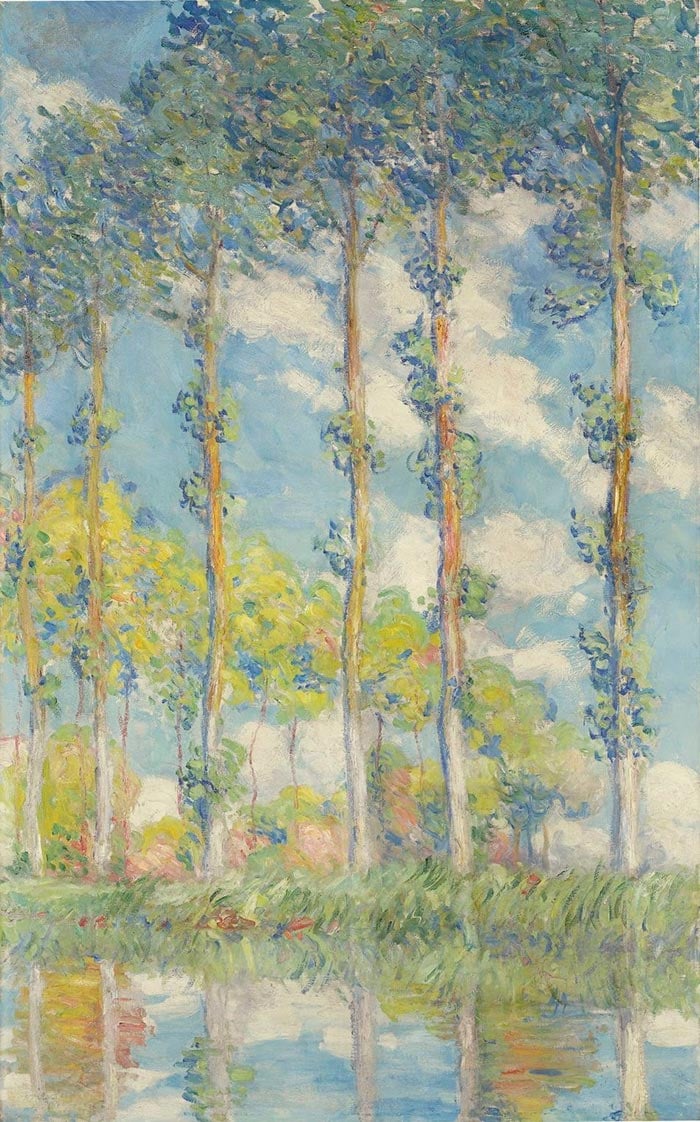
Claude Monet, Poplar, 1891
(If you desire to acquire more nearly color, brand certain to grab my free Colour Theory Cheat Canvas).
Positioning Your Hard Edges
Our eyes tend to be drawn towards hard edges, so information technology makes sense to position your hardest edges close to your focal signal. This mimics the way nosotros encounter in life: nosotros see hard edges on things we are focusing, but everything else gets soft and blurry.
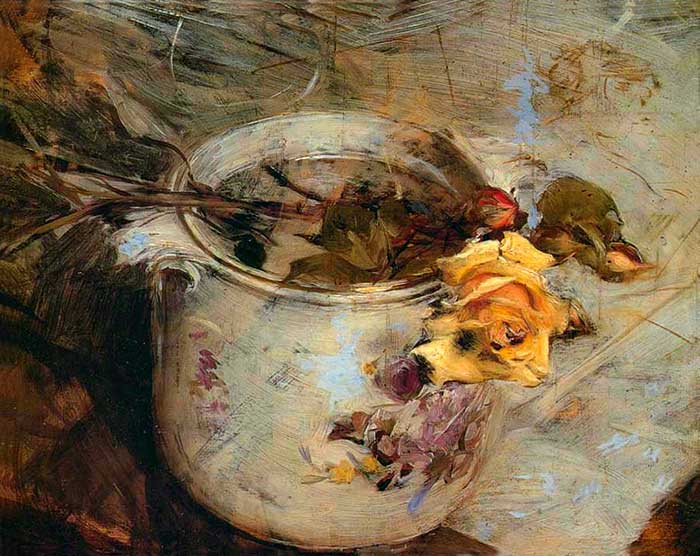
Giovanni Boldini, The Rose in Vase of Sassonia
(If y'all desire to learn more than nearly the principles of art, y'all might be interested in my Painting University form.)
Primal Takeaways
- We run across edges whenever there is a change in object, plane or colour.
- We describe edges using terms similar hard, soft and lost. But, be enlightened that these terms are limited in describing all the intricacies of edges.
- The environment, among other factors, can accept a powerful influence on the edges we see. Edges on a subject field will seem muchharder under the clear, midday sun than on a foggy morn.
- Comparison is an effective tool for ranking edges in terms of hardness.
- Edges provide an incredible amount of information about the subject field, and so make sure you are providing the right data.
- Blending is the nearly common way of painting edges, but you could also use cleaved color, palette knives or intermediate colors.
- In most cases, you should place your hardest edges around the focal point.
Thank you for Reading!
Thanks for taking the fourth dimension to read this postal service. I capeesh it! Experience free to share with friends. If yous want more painting tips, check out my Painting Academy course.
Happy painting!

Dan Scott
Draw Paint Academy
0 Response to "What Do You Call Art Animation With Sharp Edgeds"
Post a Comment